The dated fact: what the city approved
On 22 May 2025, New York City announced that Empire State Development directors had approved an amendment to the project plan for 5 Times Square. The announcement described up to 1,250 rental homes, including approximately 313 permanently affordable homes. It expected construction to start by the end of 2025 and the first phase to finish in 2027. These were the quantities and expectations in that announcement, not a September 2026 count of occupied apartments. [nyc]
That distinction belongs next to the number. “Up to” describes the proposal’s ceiling; “first phase” does not mean every home is complete. An approval announcement is evidence of that approval. It cannot, by itself, establish the status of later permits, inspections, construction milestones or available rentals.
The ESD project overview identifies the same conversion and affordable-housing component. Its overview language still describes seeking a plan modification, whereas the dated city release reports approval. We use the dated announcement for that milestone and do not infer that approval was reversed merely because an overview was not fully updated. [esd]
Six questions between a headline and a home
A useful timeline records different kinds of evidence rather than drawing one uninterrupted arrow toward a guaranteed opening date. Some activities overlap: financing can develop alongside approvals; leasing can start before the whole building is finished. The sequence below is an explanatory checklist, not a claim that every conversion follows an identical legal path.
| Question | What could answer it | What it does not establish |
|---|---|---|
| What is proposed? | Dated project announcement and stated scope | Final unit count or available rentals |
| What planning action occurred? | Named approval, resolution or project-plan amendment | All building permits |
| What construction is authorised? | Property-specific permit and approved scope | That all authorised work is finished |
| What work is complete? | Inspection and completion records for that work | Legal occupancy of every floor |
| What can be occupied? | Applicable Certificate or Temporary Certificate of Occupancy | A vacancy, asking rent or signed lease |
| What can this renter secure? | Verified unit, lease terms and move-in arrangements | Future availability for other applicants |
An occupancy document answers a different question
NYC Department of Buildings explains that a change in use, egress or occupancy requires the appropriate current or amended Certificate of Occupancy. A Temporary Certificate of Occupancy can permit occupancy before a final certificate, subject to its scope and conditions. A project’s occupancy evidence therefore needs to be read at the building or portion-of-building level. [dob]
We have not independently retrieved a current 5 Times Square permit or occupancy certificate for this article. That gap means we cannot say the project currently has, or lacks, a particular permission. General rules about certificates do not settle a specific building’s status. A dated official announcement and a completed property search are different research tasks.
For your own inquiry, keep the address, building identification and document dates together. A certificate for one portion does not automatically answer a question about another apartment. Likewise, a marketing phrase such as “now leasing” should lead to a unit-specific availability check; it is not a substitute for the relevant occupancy record.
Why one office floor is not a ready-made apartment plan
An office and a home ask different things of the same structure. An office can organise large shared areas around service cores. Homes need their own layouts, services and routes of access. The practical questions include where residential rooms sit, how plumbing reaches them, how people enter and leave, and which building systems the work changes. The answers depend on the actual building.
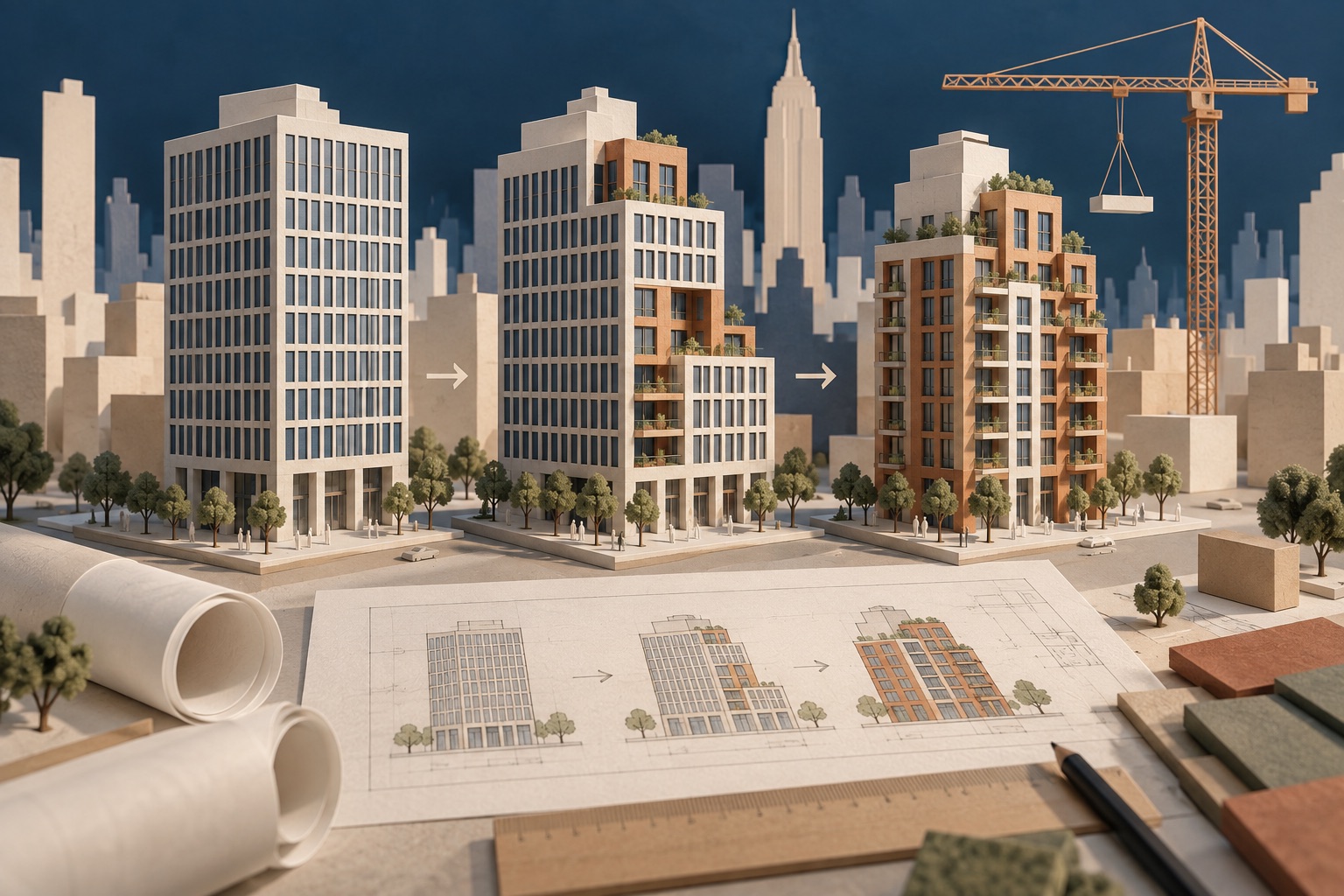
A conceptual drawing can make those questions easier to see, but it cannot reveal where an existing shaft, structural member or window actually sits. The illustration in this story depicts invented buildings. It is not a rendering of 5 Times Square, a survey, an approved plan or evidence that a particular design is feasible.
This is also why an announced floor area is not a reliable do-it-yourself apartment count. Dividing office square footage by a preferred apartment size leaves out circulation, building services, shared spaces and the design’s actual constraints. Read the project’s stated unit total with its qualifications instead of replacing it with a deceptively exact calculation.
A pipeline has homes at different stages
The NYC Comptroller’s July 2025 conversion report includes retrospective examples such as 160 Water Street and separates its analysis of conversion economics from the broader development pipeline. The report is useful background, but its project descriptions retain their observation dates. A statement about leasing or anticipated completion in a 2025 report is not a live apartment availability feed. [comptroller]
When two headlines give different totals, first check whether they count potential buildings, announced units, permitted units, completed units or homes already occupied. Next check geography and dates. A larger pipeline can coexist with a much smaller number of immediately available homes without either figure being inherently wrong.
Nor does one project supply an automatic rent forecast. Its eventual effect depends on when units become available, their rents and eligibility, the local market and what else is happening. This article does not estimate a neighbourhood rent reduction, a delivery probability or an investment return.
What to save before planning a move
Keep a short evidence file: the exact address; the dated announcement; the approval being described; the latest property-specific construction or occupancy document you have actually checked; and the current rental contact and written terms. Label a target completion date as planned until stronger evidence changes its status.
For an affordable unit, obtain the actual programme and application details when available. A headline reference to an income measure is not enough to determine your household’s eligibility. Household size, the applicable programme and the published application requirements matter; do not turn a project-level percentage into one universal salary cut-off.
The next meaningful update to this story will be a verified project milestone, not a newly worded version of the old announcement. For the building-design background, read why many new apartments share familiar forms. When a rental offer is genuinely available, read its promotion as a full lease cash flow.
Read the underlying guidance.
- 5 Times Square office-to-housing transformation — 22 May 2025NYC Mayor’s Office · checked 2026-09-28. Dated project approval, proposed quantities and then-forecast schedule; not current occupancy.
- 5 Times Square project overviewEmpire State Development · checked 2026-09-28. Project identity and plan overview; page contains pre-approval wording.
- Certificate of OccupancyNYC Department of Buildings · checked 2026-09-28. General CO/TCO and change-of-use guidance, not a property-specific search.
- Office-to-Residential Conversions in NYC — July 2025NYC Comptroller · checked 2026-09-28. Dated retrospective and economic context; no live listing or new September project status.
Source and arithmetic checks by the producing AI, followed by a separate AI editorial review. Human English editing and subject-specialist review have not been completed. Current property-specific permits, construction and CO/TCO status; available rental terms; architectural and human English review.