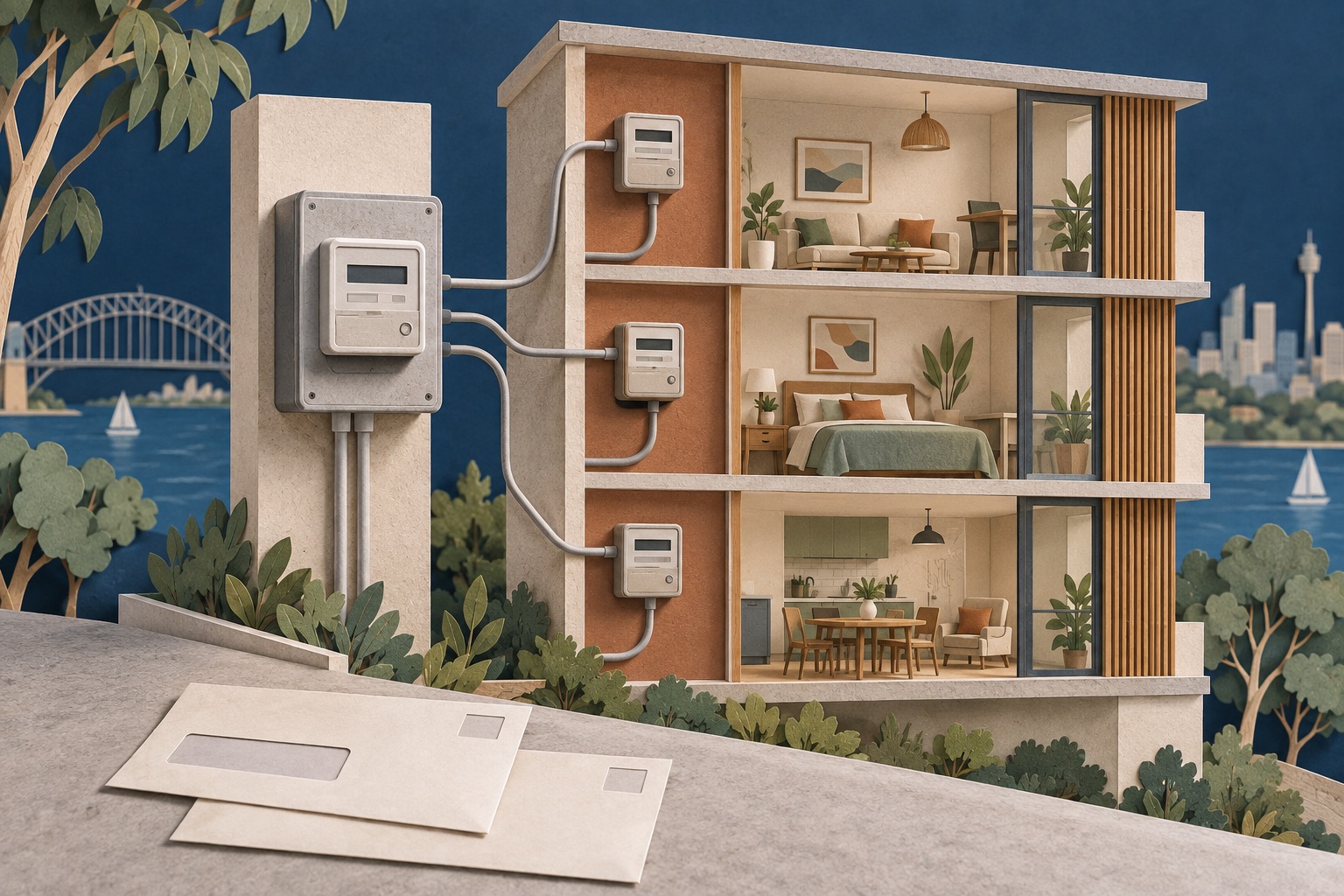
One physical supply, several commercial roles
AER describes private networks where bulk-purchased electricity is sold on to occupants. Sellers may be exempt rather than fully authorised retailers. [aer]
For your comparison, make a two-column record: the organisations involved, and the written responsibilities each one confirms.
The diagram-like illustration in this article is an invented arrangement. It is not a wiring plan or evidence about a named apartment building. Use it to organise questions, then confirm the actual roles using the building’s documents.
| Part of the arrangement | Question to ask | Document to request |
|---|---|---|
| Site connection/private network | Who operates it and charges for access? | Network terms and applicable charges |
| Apartment meter | Can an outside retailer supply this metering arrangement? | Meter/supply information supplied privately |
| Energy seller | Is it an authorised retailer or an exempt seller? | Seller identity, contract and applicable status |
| Alternative retailer | Which energy and network components does the quote include? | Written offer for this actual premises |
| Household bill | Who charges each component after any switch? | Itemised billing explanation |
Why an advertised offer may not be immediately usable
Network and metering arrangements, and retailer willingness to supply, can constrain switching. That is not a universal prohibition. [aer]
Ask the prospective retailer whether the offer is available at the specific premises under the current arrangement. Ask what needs to happen before supply can start and which organisation handles each step. If a proposed change has a cost, request the amount and basis in writing instead of assuming that every technical step is free, or that every possible charge applies.
The building manager may hold useful information, but do not treat a verbal summary as a replacement for the relevant written supply terms. Nor should you assume that the manager and the energy seller are legally the same business. Record the names and roles before comparing prices.
The bill to watch for: two network charges
AER advises checking network-charge allocation when switching, including an energy-only offer where appropriate, to avoid paying network charges twice. [aer]
Imagine two blank comparison columns rather than inserting invented household rates. In the first, list the existing energy charge, network-related charge and any other applicable compulsory charge. In the second, list what the new retailer includes, what the private network would still charge and any documented transition cost. If a row is unknown, mark it unknown rather than zero.
Then compare the same usage and period. A percentage saving calculated from the new retailer’s portion alone does not establish the change in total household spending. The related guide to electricity discounts and the whole bill explains the arithmetic; this article explains why the offer’s scope must be settled first.
NSW changes: keep the commencement dates separate
IPART’s customer guidance distinguishes requirements from 1 July 2026, including seller participation in the Energy & Water Ombudsman NSW scheme and publication of services and prices, from maximum-price and new billing requirements expected in the first half of 2027. As checked for this article, an expected future start should not be reported as a price cap already reducing every apartment bill. [ipart]
The AER’s separate 2025 Embedded Network Review also introduced revised exemption-guideline protections with different start dates and scopes. Its announcement includes some seller information duties effective 1 July 2026. The NSW reform timetable and the national exemptions framework should not be collapsed into one rule that supposedly applies identically to every seller. [review]
The practical question is which rule applies to your seller and situation now. An authorised retailer’s obligations are not automatically identical to those of an exempt onseller. This is a guide to the regulators’ consumer information, not a full legal assessment of every exemption class or a determination of a particular bill dispute.
Use the bill to gather facts, not to guess the wiring
Start with the seller’s legal name and contact details, the supplied premises, the billing period and the itemised charges. Ask who operates the private network and whether the offer includes that network’s charges. Keep account identifiers and meter information private when discussing the issue publicly.
AER’s 2023 letter on its Better Bills Guideline addresses small customers of authorised retailers in embedded networks, including both on-market and off-market arrangements. That is useful scope guidance; it is not proof that every exempt seller was subject to precisely the same billing rules at the same time. [bills]
If the bill does not give you enough information to compare offers, the next step is to request the missing explanation. You do not need to diagnose the building’s electrical system from a photograph of a meter. You need an accountable answer about who supplies and bills each part.
Questions to send before agreeing to a switch
Ask: Can this retailer serve my exact premises and current meter? Which company remains responsible for the private network? Does the quote include network charges, or are they billed separately? What one-off costs and timing conditions are documented? How will the existing account close, and how can I identify any overlapping charges?
Keep the written response with the offer date and validity period. A quote that assumes a different metering arrangement is not yet comparable. An unanswered fee is not automatically an improper fee, but it also should not disappear from the comparison simply because the headline price looks attractive.
For unresolved billing or service concerns, raise the issue with the seller first. IPART directs NSW customers to EWON for relevant unresolved complaints; EWON explains its complaint process. Those routes do not guarantee that an individual claim will succeed, but they provide a way to get the issue considered without publicly sharing private account details. [ewon]
Before moving in, check the supply arrangement
A prospective tenant or buyer can ask whether the home is in an embedded network before relying on a comparison-site tariff in a household budget. Request current seller and charge information, then confirm what alternatives are actually available. Avoid assuming that all apartments in a city share one arrangement.
For a wider view of shared-building costs, read NSW strata repair costs before buying. The older energy-performance explainer concerns a different jurisdiction, but shares one useful distinction: a building characteristic alone is not a household bill.
The aim is a complete, comparable offer and a clear set of responsibilities. Whether switching is worthwhile or possible at your address needs the actual contract and metering facts, which this article has not collected for a named household.
Read the underlying guidance.
- Embedded network customersAustralian Energy Regulator · checked 2026-09-28. Network/seller structure, switching constraints and network-charge allocation.
- Information for embedded network customersIPART · checked 2026-09-28. NSWJuly 2026 duties separated from expected 2027 price/billing requirements.
- Embedded Network Review final decision —29 August 2025Australian Energy Regulator · checked 2026-09-28. Revised exemption guidelines, staged implementation and qualified scope.
- Letter: embedded-network customers —26 July 2023Australian Energy Regulator · checked 2026-09-28. BetterBills scope for authorised retailers, not every exempt seller.
- Making a complaintEnergy & Water Ombudsman NSW · checked 2026-09-28. Consumer complaint route, not a promised individual outcome.
Source and arithmetic checks by the producing AI, followed by a separate AI editorial review. Human English editing and subject-specialist review have not been completed. A named building’s seller/network/meter terms, anonymised bill and actual switching eligibility; human English and legal/energy-specialist review.